
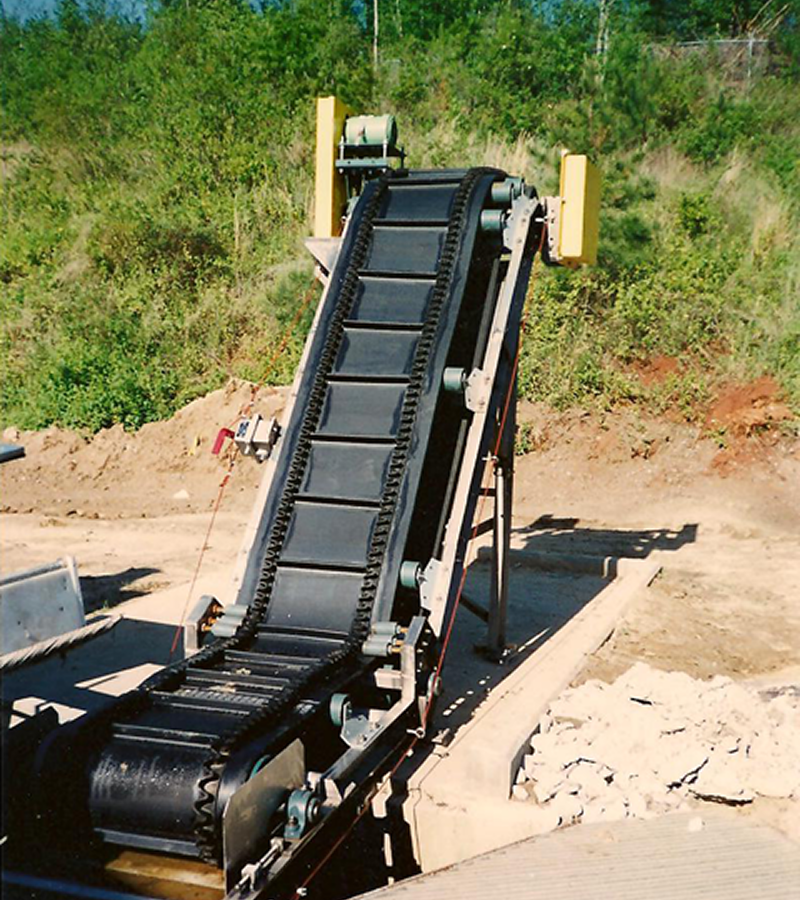
If you are deciding how to choose a belt conveyor for bulk materials, start with the application, not a catalog guess. The material, required flow, route, transfer points and operating environment all affect whether a design will run reliably. This conveyor belt selection guide explains what to define before selecting equipment, how common configurations differ, and what information to bring to a conveyor design review.
Keystone Conveyor designs custom equipment for industrial and municipal material-handling projects, including new installations, replacements and retrofits. Use the steps below to shape a practical specification and start a productive conversation with a conveyor manufacturer.
What is a belt conveyor for bulk materials?
A belt conveyor moves loose material on a continuously moving belt supported by rollers or a bed and driven around pulleys. Feed enters at a loading point, travels along the conveyor, and leaves at a discharge point. The basic idea is simple; making the system work well means matching the belt, supporting structure, drive, loading arrangement and route to the material and duty.
Bulk conveyors are used to move products such as aggregate, sand, gravel, recycled material and other bulk solids between process stages. A well-selected system can provide a steady flow while reducing repeated handling. The right choice depends on the whole application, not just the commodity name or conveyor length.
1. Define the material and operating duty
Start with a clear description of what will travel on the belt and how the plant will operate. Two materials with similar average size may behave very differently once they are wet, dusty, sharp, sticky or delivered in surges. The more accurately the duty is described, the more useful a conveyor recommendation will be.
Record material characteristics
- Bulk density: Note the expected range, including changes with moisture or compaction. Density affects the mass carried in a given volume.
- Particle size and lump size: Include the largest pieces as well as the typical grading. Large or irregular lumps influence loading, belt width and impact protection.
- Abrasiveness and sharp edges: These affect belt cover selection, wear surfaces and the design of loading and transfer areas.
- Moisture and flowability: Damp or cohesive material may cling to the belt, bridge in a chute or release differently at discharge than dry, free-flowing material.
- Temperature and chemistry: State normal and unusual operating temperatures and any oils, chemicals or other exposure that could affect belt and component materials.
- Dust and spillage concerns: Identify locations where containment, cleanup access or dust controls are especially important.
Use representative material data rather than a best-case sample. If the feed varies by season, supplier or process step, share the range and the conditions that create it. This helps the design team consider the demanding operating case without treating every minute as an extreme event.
2. Specify capacity, not just conveyor speed
For belt conveyor sizing, describe the required throughput in the units your operation uses, such as tons per hour, and distinguish normal production from short-term peak flow. A conveyor that meets the average rate may still bottleneck the process if upstream equipment releases material in bursts or if downstream equipment cannot accept a continuous stream.
Capacity is tied to how much material occupies the belt cross-section and how quickly that cross-section moves. Both depend on the material and the system layout: belt width, belt speed, loading profile, trough shape, particle size, incline and transfer arrangement all matter. Increasing speed alone is not a universal fix; it can change loading behavior, dust, wear and the way material reaches the discharge.
When reviewing belt conveyor equipment, provide the required sustained rate, peak rate and expected hours of operation. Also identify whether the conveyor will start loaded, run intermittently, reverse, or feed multiple destinations. These details influence drive and control requirements as well as the mechanical design.
3. Map the route, incline and available space
Sketch the path from the feed point to the receiving equipment. Include horizontal distance, vertical rise, changes in elevation, obstacles, columns, access aisles, existing structures and the available footprint. A layout drawing or a few annotated site photographs can reveal constraints that are hard to describe in a capacity number.
Incline is important because material must remain stable on the moving belt. The workable angle depends on the material’s characteristics, belt surface, loading profile and whether cleats or sidewalls are appropriate. There is no single maximum angle that applies to every bulk solid and every belt. Where a steep route is needed, compare a specialized belt arrangement with a different conveyor type or a revised transfer elevation.
Consider the complete path, including the return side of the belt, drive and take-up locations, maintenance access and clearances for removing components. A compact arrangement may fit the building but leave little room to inspect or service the system. Plan for both production flow and the people who will operate and maintain the equipment.
4. Compare conveyor configurations
Configuration should follow the job. A standard belt arrangement may suit a continuous route, while a steep incline, restricted profile or changing discharge location can call for a different design. The table is a starting point for discussion; final selection depends on the material, capacity and site.
| Configuration | Often considered for | Key selection question |
|---|---|---|
| Troughing idler belt | Continuous movement of loose bulk material on a defined route | Will the belt profile and loading arrangement contain the material at the required rate? |
| Slider bed | Applications needing continuous belt support or a compact conveying surface | Are the load, material abrasiveness and operating conditions suitable for the chosen bed and belt? |
| Sidewall or cleated belt | Inclines or transitions where a flat belt profile may not retain the material | Can the belt geometry, cleat spacing and feed pattern carry the material without rollback or interference? |
| Shuttle conveyor | Reciprocating movement to serve more than one loading position | How should travel, discharge points and process controls coordinate with receiving bins? |
| Pivoting or stack-out conveyor | Distributing material across a stockpile or multiple discharge locations | What reach, movement envelope and pile shape are required at the site? |
For a conventional continuous bulk route, a troughed conveyor is one configuration to evaluate. If the process needs stockpiling or more than one discharge point, discuss the required movement and destination layout early. A comparison should include how each option interfaces with upstream and downstream equipment, not just the conveyor itself.
5. Match the belt, drive and structure to the material
The belt is selected for more than width. Its cover and construction must suit the material and the duty, including abrasion, temperature, moisture, chemical exposure and the impact expected at loading. The belt also has to track reliably through the route and work with the pulleys, rollers, cleaners and take-up arrangement. A belt chosen only by commodity name can miss important differences in grading and operating conditions.
The drive must move the belt and its load through startup and normal operation. Conveyor length, elevation change, loading, friction and operating schedule affect the required drive arrangement. If the conveyor starts full, cycles often or must coordinate with other equipment, state that when the design is reviewed. The take-up maintains appropriate belt tension as required by the design; its arrangement also affects service access and available space.
Structure and belt support should reflect the loading conditions and environment. Discuss loading-zone impact, belt support, idler arrangement, skirt or containment needs, and access for inspection. Keystone’s application design support includes system layout drawings and reference specifications, which can help connect these decisions to the plant arrangement.
6. Design the feed and discharge points
Many operating problems begin where material enters or leaves the belt. A feed chute should deliver material in a controlled manner and in a direction that supports belt travel. Poorly distributed or off-center loading can contribute to mistracking and spillage. Large lumps or a significant drop can create impact that must be considered when specifying support and wear protection.
At discharge, confirm the height, direction and receiving equipment. Material may need to enter a bin, another conveyor, a screen or a stockpile. Its trajectory and flow characteristics affect chute geometry and transfer arrangement. Account for cleanout access, wear components and the possibility that material may adhere or build up. A conveyor can have adequate rated capacity and still disrupt the process if its transfer point is poorly matched to the next stage.
Include the location of every feed and discharge point on the layout. If the system must deliver to several destinations, identify which are simultaneous, which are alternate, and how the operator will select them. Keystone’s broader material-handling services can help teams consider a conveyor within the larger process rather than as an isolated machine.
7. Account for the environment and maintenance plan
Indoor and outdoor installations face different conditions. Dust, rain, snow, freezing temperatures, heat, washdown, corrosion and nearby process equipment may affect component selection, guarding and access. Explain whether the conveyor is exposed to weather and how the area is cleaned. If dust containment or collection is needed, define the affected transfer points and coordinate that requirement with the full system design.
Maintenance access is part of equipment selection. Operators need practical ways to inspect the belt, rollers, drive, take-up, cleaners and transfer points. Identify routine service tasks and the space needed to reach or remove components. Guarding, emergency stops and other safety provisions must be addressed for the actual installation and applicable requirements; they should be reviewed as part of design, not added as an afterthought.
Ask how the proposed arrangement supports inspection, cleanup and replacement of wear parts. A design that is straightforward to service can help reduce avoidable downtime over its operating life. Also discuss expected operating hours, available maintenance windows and any critical spares or response expectations that should inform the project.
A practical belt conveyor selection checklist
The bulk material conveyor design process goes more smoothly when you gather the details below before requesting a review or budget quotation. You do not need to resolve every engineering detail yourself; the goal is to describe the application accurately enough for a useful first conversation.
- Material name, grading, largest lump, bulk density range, moisture and any unusual temperature or chemical exposure.
- Normal and peak throughput, operating hours, feed pattern and whether the conveyor starts loaded or runs intermittently.
- A route sketch with length, elevation changes, incline, obstacles, loading points and required discharge locations.
- Upstream and downstream equipment, transfer heights, bin or stockpile needs and control expectations.
- Indoor or outdoor conditions, dust or spillage priorities, cleanup method and access constraints.
- Project scope: new system, replacement, retrofit or equipment that must fit existing supports and connections.
With these details, a manufacturer can discuss configuration, sizing assumptions, belt and component choices, layout and open questions. Keystone’s project gallery offers additional context on its material-handling work; an existing installation is a reference point, not a substitute for application-specific design.
Frequently asked questions
How do I choose a belt conveyor for bulk materials?
Start with the material properties and required throughput, then map the route, incline, feed and discharge points, environment and maintenance access. Compare configurations against the complete duty and confirm sizing with a qualified conveyor design team.
What information is needed to size a bulk conveyor?
Provide normal and peak flow, bulk density, particle and lump size, material condition, conveyor length and elevation, loading arrangement, operating schedule and discharge requirements. Site drawings or photos can clarify space and connection constraints.
What determines belt width?
Belt width is selected in relation to capacity, belt speed, material cross-section, lump size, loading and containment needs. The usable belt area and material behavior matter, so width should be determined as part of the system design rather than from throughput alone.
Can a belt conveyor handle an incline?
Yes, when the material, belt surface and conveyor geometry are suited to the incline. The acceptable angle varies with the material and operating conditions. Cleats, sidewalls, a different configuration or a revised route may be considered when a standard belt cannot retain the load reliably.
Are belt conveyors suitable for abrasive aggregate?
They can be, but the belt cover, loading-zone support, transfer points and wear components should be selected for the aggregate’s grading, sharpness and impact conditions. Share the actual material range and duty so the equipment can be reviewed for those conditions.
Can an existing conveyor be replaced or retrofitted?
Often, but the existing supports, drive, transfer points and surrounding equipment need to be assessed. Document what should remain, what is failing, the current operating rate and any changed process requirements. A replacement should be designed around verified site conditions, not assumed dimensions.
Plan the conveyor around the whole process
The best belt conveyor is the one that matches the real material, capacity, route and operating environment while remaining practical to inspect and maintain. Define the duty, map the connections, compare configurations and resolve transfer-point questions before locking in equipment details.
Planning a new bulk-handling line or updating an existing one? Share your material, flow rate, layout and project constraints with Keystone Conveyor’s team. Their team can discuss application design, equipment configuration and the next steps for a conveyor system tailored to your operation.
